

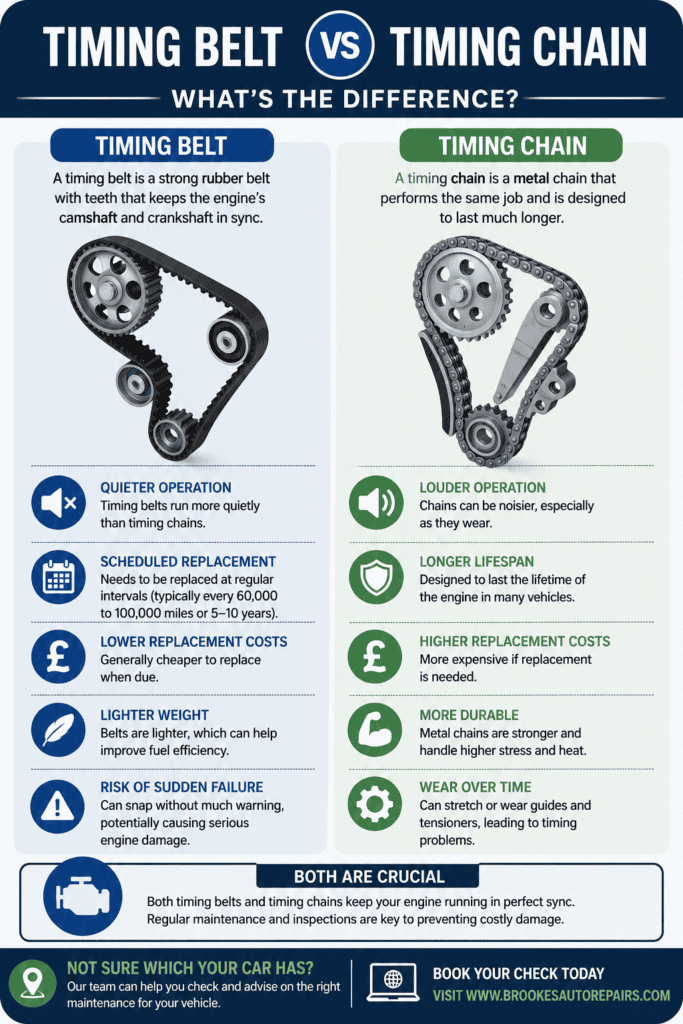
Most drivers have heard mechanics mention timing belts or timing chains, but many people are unsure what they actually do — or why they matter so much.
Both parts perform the same essential job inside your engine: they synchronise the crankshaft and camshaft so the engine’s valves and pistons move in perfect timing. If that timing fails, serious engine damage can occur.
Understanding the difference between a timing chain and a timing belt can help drivers avoid expensive repairs and make better maintenance decisions.
What Is a Timing Belt?
A timing belt is a reinforced rubber belt with teeth that keeps the engine components rotating in sync.
Timing belts are:
- Usually quieter
- Lighter than chains
- Common in many petrol and diesel vehicles
Because they are made from rubber, timing belts wear out over time and must be replaced at scheduled intervals.
Manufacturers often recommend replacement somewhere between:
- 60,000 to 100,000 miles, or
- Every 5–10 years
The exact interval depends on the vehicle manufacturer.
What Is a Timing Chain?
A timing chain performs the same role but is made from metal, similar to a bicycle chain.
Timing chains are:
- Stronger and more durable
- Usually designed to last much longer
- Common in many modern engines
Unlike belts, timing chains often do not have fixed replacement intervals. However, they can still wear, stretch, or develop tensioner problems over time.
Main Differences Between Timing Chains and Timing Belts
| Timing Belt | Timing Chain |
|---|---|
| Made from reinforced rubber | Made from metal |
| Usually quieter | Often slightly noisier |
| Requires scheduled replacement | Often designed for long-term use |
| Generally cheaper to replace | Usually more expensive repairs |
| Can deteriorate with age | Can stretch or tensioners can fail |
What Happens if a Timing Belt Breaks?
A snapped timing belt can cause catastrophic engine damage in many vehicles.
This may include:
- Bent valves
- Damaged pistons
- Cylinder head damage
- Complete engine failure
Because of this risk, replacing the belt at the correct interval is extremely important.
What Happens if a Timing Chain Fails?
Timing chains are generally more durable, but they are not indestructible.
Common timing chain issues include:
- Chain stretching
- Worn guides
- Failed tensioners
- Rattling noises during startup
If ignored, timing chain failure can also lead to major internal engine damage.
Common Warning Signs of Timing Problems
Whether your vehicle uses a belt or chain, warning signs can include:
Rattling Engine Noise
Especially during cold starts, this can indicate a worn timing chain or tensioner.
Engine Misfires
Incorrect valve timing can affect engine performance and smooth running.
Loss of Power
Poor timing may reduce acceleration and fuel efficiency.
Engine Warning Light
Modern vehicles may detect timing-related faults electronically.
Difficulty Starting
Serious timing issues can affect ignition timing and compression.
If these symptoms appear, it’s important to have the vehicle inspected promptly.
Which Is Better: Timing Chain or Timing Belt?
Neither system is automatically “better” — they simply have different advantages.
Timing Belt Advantages
- Quieter operation
- Lower manufacturing costs
- Often cheaper engine design
Timing Chain Advantages
- Longer lifespan
- More durable under high mileage
- Typically fewer scheduled replacements
However, timing chain repairs can sometimes be significantly more expensive if problems develop.
How Do You Know Which Your Car Uses?
The easiest ways to check are:
- Your owner’s manual
- Manufacturer service schedules
- Asking a trusted garage
Different engines from the same manufacturer may use different systems, so it’s important not to assume.
Why Preventative Maintenance Matters
Ignoring timing system maintenance can lead to some of the most expensive engine repairs drivers face.
Regular servicing helps:
- Identify wear early
- Prevent unexpected breakdowns
- Maintain engine performance
- Reduce long-term repair costs
For drivers in the Swansea Valley and Ystradgynlais area, local garages such as Brookes Auto Repairs can inspect timing-related symptoms, diagnose engine noises, and advise whether a timing belt replacement or further investigation is needed. (brookesandcarlson.co.uk)
Final Thoughts
Timing belts and timing chains both play a vital role in keeping your engine running correctly.
The key difference is that:
- Timing belts require scheduled replacement
- Timing chains are generally longer lasting but can still fail
Understanding which system your vehicle uses — and recognising the warning signs of wear — can help drivers avoid serious engine damage and costly repairs later on.