
Most drivers assume a franchise badge means better reliability. Walk into a main dealer, hand over your keys, and whatever happens next feels safer somehow. The brand on the wall carries a kind of implied guarantee. That assumption is worth examining carefully, because it rarely survives contact with reality.
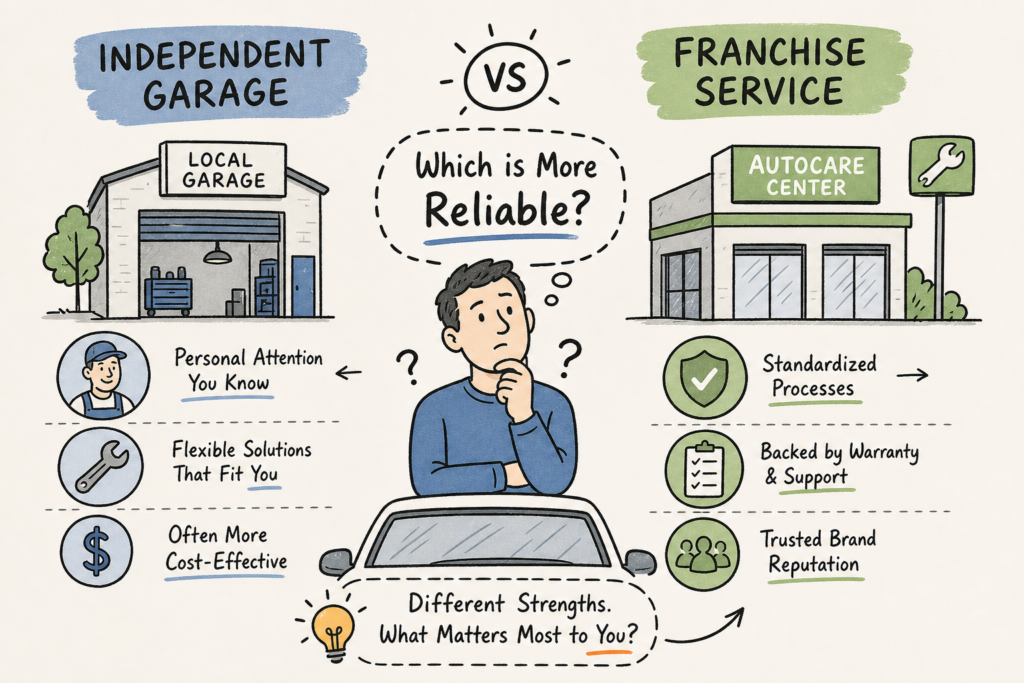
When comparing an independent garage vs franchise garage for reliability, the logo above the door tells you almost nothing useful. What matters is the experience of the technicians, the transparency of the process, and the accountability built into how the garage operates. Those things exist, or they don’t, regardless of whether a garage is independently owned or tied to a manufacturer network. Understanding the actual differences helps you make a smarter choice every time you need work done.
Before we get into specifics, it helps to define what reliability actually means, because most drivers are working from a definition that’s too narrow.
What “reliable” actually means for car repairs
Most drivers use the word loosely. A repair held up, so the garage was reliable. But that’s just one data point. Real reliability has three dimensions: the repair holds over time, the diagnosis was accurate in the first place, and the experience is honest and consistent across every visit.
A single successful job doesn’t make a garage reliable. Reliability is a pattern, consistent diagnostics, clear communication before work starts, and repeat quality that builds trust across months and years. A franchise logo doesn’t guarantee any of that. Neither does the absence of one.
There’s also a cognitive bias worth naming. Many drivers assume a main dealer carries less risk because of manufacturer backing and brand recognition. That assumption has some merit for warranty and recall work on new cars. But for out-of-warranty vehicles, which describes most cars on UK roads, the structural advantage of a franchise service centre largely disappears. That’s where the real comparison between an independent garage and a franchise dealer begins.
Independent garage vs franchise garage for reliability: technician experience
Franchise service centres train their technicians deeply on one manufacturer’s systems. That’s genuinely valuable for warranty repairs, software updates, and recall work. The technician knows the platform inside out, has access to proprietary diagnostic tools, and follows procedures designed for that specific vehicle architecture.
The limitation shows up in out-of-warranty work. Brand-specialist training creates a narrow field of view. When a fault doesn’t match a known pattern, franchise technicians can tend toward replacing whole assemblies rather than diagnosing and fixing the actual fault. It’s the safer option for the service centre, but it costs the driver significantly more.
Independent mechanics who have worked across dozens of makes and models develop something different: broad pattern recognition. They have seen the same failure modes appear across manufacturers, in different forms, across hundreds of vehicles. That breadth builds diagnostic instincts that brand-specific training doesn’t produce. Fixing the solenoid instead of replacing the whole gearbox is a product of that experience. Consumer Reports, while US-based, and UK industry commentary from organisations such as the RAC and Which? consistently indicate that independents with certified technicians match or exceed dealer-level quality for most repairs outside warranty work.
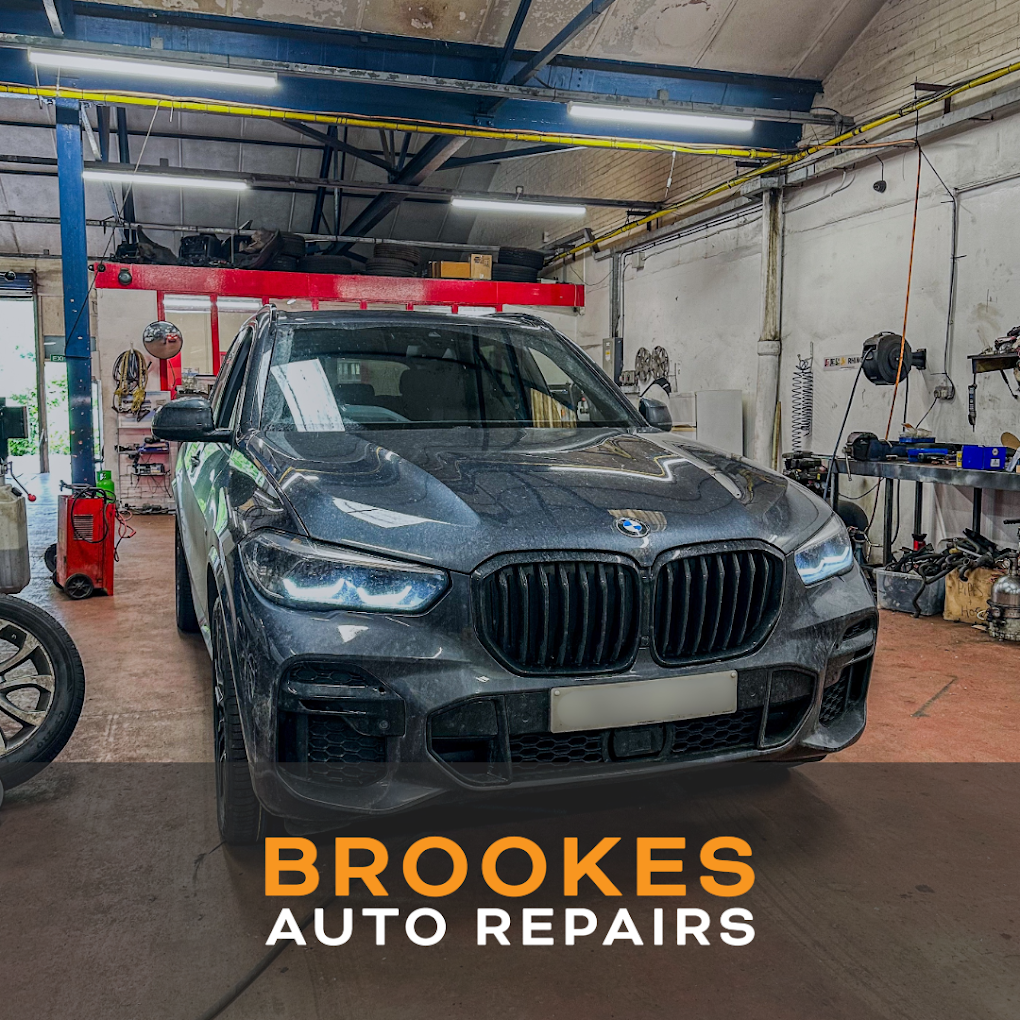
At Brookes Auto Repairs in Ystradgynlais, that multi-vehicle experience is combined with advanced diagnostic equipment covering a full range of makes. The team handles everything from timing chain replacements and head gasket work to clutch repairs and custom exhaust fabrication, the kind of technical range that takes years to build.
Pricing transparency and the franchise premium
The cost gap between independent garages and franchise dealers is consistent and significant. According to Checkatrade industry data, independents charge an average of around £56 per hour for labour, while main dealers average closer to £99. For a full service with MOT, that gap translates to several hundred pounds over the course of a year’s ownership. For major repairs like clutch replacement or engine work, the difference is larger still.
What drives that premium? Higher overheads, OEM-only parts policies often at significant markup, and in some cases a tendency to approve additional work without thorough explanation. For an accessible overview of the relative advantages and drawbacks, see the pros and cons of franchise and independent dealers. For out-of-warranty vehicles, drivers are frequently paying for brand association rather than genuinely better service.
The warranty concern that keeps many drivers at main dealers is, for most, a misunderstanding of UK law. Under the UK’s retained Motor Vehicle Block Exemption Order (MVBEO), with guidance from the Competition and Markets Authority, manufacturers cannot void your warranty simply because you used an independent garage, provided the work follows manufacturer specifications and you keep proper service records. The MVBEO also requires manufacturers to give independent garages access to the same technical data and diagnostic tools as authorised dealers. This changes the risk calculation for most drivers entirely.
That said, if your car is brand new and under an active free maintenance programme, use it. Brands like Volkswagen and Toyota offer multi-year free servicing, and there is no reason not to take advantage. But once that period ends, you have full legal freedom to take your vehicle wherever offers the best combination of quality and value.
Parts quality: when OEM matters and when it doesn’t
The strongest argument for franchise dealers is OEM parts. Genuine manufacturer components are designed to exact specifications for your vehicle, tested to integrate with its systems, and backed by the manufacturer’s own quality controls. For specific situations, that matters.
Those situations include: new vehicles under warranty where non-OEM parts could complicate a claim, safety-critical components like airbag systems, and parts with complex electronic compatibility requirements. In these cases, a franchise dealer has a genuine structural advantage, and it is worth acknowledging that directly.
For the majority of repairs, though, the OEM argument does not hold up the way people assume. Quality branded aftermarket parts from recognised suppliers, certified to standards such as those set by CAPA or equivalent UK industry bodies, meet or exceed OEM specifications for most common jobs. Brakes, clutches, filters, belts, exhaust components: well-tested aftermarket alternatives perform comparably at lower cost. The real risk is not OEM versus aftermarket; it is quality-controlled parts versus generic, unverified ones sourced for cost alone. That risk exists at any garage, independent or franchised. A reputable independent sources from recognised suppliers and can obtain OEM parts when the job genuinely calls for them.
Independent garage vs franchise garage for reliability: accountability and continuity
This is where independent garages hold a structural advantage that franchise service centres find hard to match. When the same mechanic works on your car over months and years, they build knowledge of that specific vehicle’s history. They remember what was flagged last time. They notice when something has changed. That accumulated knowledge improves diagnostic accuracy and may reduce the likelihood of missed or recurring faults, a benefit that is difficult to quantify but consistently noted in industry commentary on garage continuity.
Franchise service centres can operate at high volume and, in many cases, experience higher staff turnover than smaller independents. Each visit, your car may effectively be a new case file. The technician may be fully qualified, but they have no context for your vehicle beyond what is on screen. For routine work, that is manageable. For complex or recurring issues, it is a real diagnostic risk that rarely gets discussed.
Accountability at an independent garage is also more direct. At a smaller operation, there is often no management layer between a dissatisfied customer and the person who carried out the work, though this varies depending on the size of the business. At Brookes Auto Repairs, that accountability is grounded in the Ystradgynlais community. A garage with deep local roots has a direct stake in every repair it carries out. That community-first approach shows up in practical ways: checking a suspected leak on the spot, fabricating a custom exhaust bracket when a standard solution will not do, and taking the time to explain what was found and why it matters.
How to vet any garage before you hand over your keys
The question is not simply “independent or franchise?” It is “is this garage worth trusting?”, and that applies equally to both. The answers come from the same set of signals.
Questions worth asking before you book
Ask these before committing to any garage, regardless of its affiliation:
- Are your technicians certified or do they hold recognised accreditations (IMI, Bosch Car Service,Trust My Garage, AA Trusted Garages)?
- Can you provide a written quote before starting any work?
- What parts do you use, and can you source OEM if the job requires it?
- Have you worked on this specific issue on this make before?
- Will you show me the fault or the removed part if I ask?
A confident, professional garage answers all of these without hesitation. These questions also reveal a great deal about how the garage communicates. If any answer is vague, evasive, or conditional, that is worth taking seriously.
Red flags that apply equally to independents and franchise centres
Vague verbal estimates with no written follow-up are a warning sign regardless of who is issuing them. So is pressure to approve additional work without a clear explanation of what was found and why it is needed. Watch out for:
- No visible certifications or accreditations
- Reluctance to show you a fault or removed part directly
- Quoting worst-case scenarios before any diagnosis has been done
These patterns are concerning at a main dealer just as much as at any independent. The franchise badge does not make them acceptable.
The verdict: independent garage vs franchise garage for reliability
Franchise or independent: that label does not determine whether a garage is reliable. What determines it is the technician’s experience, transparency on pricing and parts, accountability to customers, and whether the garage builds genuine knowledge of your car over time. Those qualities exist at both types of operation, and they are absent at both types too.
For most out-of-warranty vehicles, a well-run independent garage offers everything a franchise dealer does, at meaningfully lower cost, with more direct accountability and better continuity of care. The MVBEO protects your warranty rights. Quality parts are available outside OEM channels. And the person who worked on your car last time will remember it next time.
You now know what to look for. Use it. If you are in the Swansea Valley and want a garage that answers all the right questions with confidence, Brookes Auto Repairs in Ystradgynlais is worth a call. Experienced technicians, honest pricing, and a reputation built on actually getting the job right.
Further reading: Mastering the First Impression: Your intriguing post title goes here, brookesautorepairs and Crafting Captivating Headlines: Your awesome post title goes here, brookesautorepairs. Visit our Blog, brookesautorepairs for more.
Frequently asked questions
Will using an independent garage void my car’s warranty?
Not if the work follows the manufacturer’s specifications and you keep proper service records. Under the UK’s retained Motor Vehicle Block Exemption Order and CMA guidance, manufacturers cannot void your warranty solely because an independent garage carried out the work. Check GOV.UK for the full CMA guidance on motor vehicle servicing. For a practical, consumer-facing discussion on whether your warranty will be honored if maintenance is done by a shop that’s not the dealership, see this overview.
Are aftermarket parts as good as OEM parts?
For most common repairs, brakes, clutches, filters, belts, quality branded aftermarket parts from recognised suppliers meet or exceed OEM specifications. The main risk is generic, unverified parts sourced purely on cost. For safety-critical components or new vehicles under warranty, OEM parts are generally the safer choice.
How do I know if an independent garage is qualified?
Look for accreditations such as IMI certification, Bosch Car Service approval, Trust My Garage membership, or AA Trusted Garages listing. These schemes require garages to meet defined standards. You can verify membership directly through each scheme’s website.
When does it make sense to use a franchise dealer?
For warranty repairs, recall work, and software updates on newer vehicles, a franchise dealer’s brand-specific training and proprietary diagnostic tools offer a genuine advantage. If your car is under a manufacturer’s free servicing programme, use it. Outside those circumstances, the case for paying the franchise premium is considerably weaker.